 |
| This is why I like a rowing boat over a paddle boat, the ability to do neither and just relax. Photo by J. Felty. |
Sunday, October 25, 2020

Thursday, September 14, 2017
15'6x5' trailerable micro cruiser
| Currently in the Shop. Possibly transportable in the back of a pickup truck, but a micro trailer cruiser. |
 |
| Minimal rocker to reduce slap under the bow. |
 |
| moderate flare to the sides and slight V bottom at the stern. |
 |
| water tight forward bulkhead for bouncy and ground tackle storage |
Hoping to have a split rig, either Cat-Ketch, or Yawl. Two rowing stations, and sculling notch. Bottom epoxy and fabric, either glass or Dynel..... Center board (weighted).
Wednesday, March 8, 2017
New Jib
A nice pre-Spring day and I got the boat out of the barn to fit the jib I just finished sewing. The jib is made from a piece of scrap from an old sail. The halyard goes thru a bee hole at the top of the mast. The luff of the sail is roped, with eyes spliced at the head and tack. The clue also has an eye sewn into it.
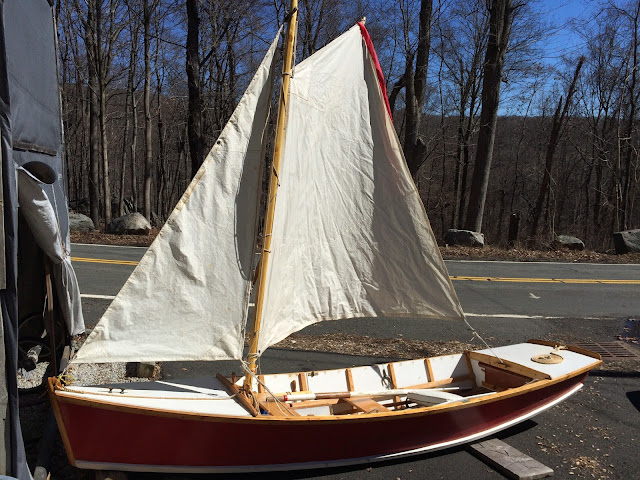 This is also the new, taller, mast. Today I made the pad eyes that I will use for sheet leads for the jib. FUN!

Saturday, November 19, 2016
Eagles and skiffs
November 16, 2016. A mid week sail.

Wednesday, November 9, 2016
A storm is brewing
Dark clouds now hover above, the rain has begun
All one can do is put a reef in the sails, batten down hatches
stow and secure what can be stowed and secured
take bearings, be as sure as possible of the course you want to sail
out on the sea the integrity of the boat is all that matters
the sea will find all of it's faults, all of the weakness,
not only of the boat but also of the crew
Just because you stand on the shore doesn't mean you are safe from the rising water
or the howling destructive winds
The land is just something granted to us by the sea
for a time
Water rules the world and the wind makes it all move and change
The river is rising and I'm stuck down low
All one can do is put a reef in the sails, batten down hatches
stow and secure what can be stowed and secured
take bearings, be as sure as possible of the course you want to sail
out on the sea the integrity of the boat is all that matters
the sea will find all of it's faults, all of the weakness,
not only of the boat but also of the crew
Just because you stand on the shore doesn't mean you are safe from the rising water
or the howling destructive winds
The land is just something granted to us by the sea
for a time
Water rules the world and the wind makes it all move and change
The river is rising and I'm stuck down low
Monday, November 7, 2016
Wind Surfers
 | ||
| Wind Surfing just north of the Tappan Zee Bridge Construction on a blustery day |
It was a fun sight and we sat in the van with the big door open drinking our coffee and eating our pastries, and looking thru the binoculars at the surfers.
I wonder if I am too old and to weak to be able to do such a thing anymore. I wonder if I would enjoy it. A board and sail rig is just about the right size for something to carry atop my under powered little vanagon. I have been struggling for coming up with some kind of craft that sails, to carry on the van, but weight is indeed a real issue.
Maybe a wind surfer. I'd need the wet suit to go with it........This doesn't sound inexpensive. The truth is I prefer to be in a boat than in the water and I don't think that wind surfing is the best way to achieve this. But it does look really, really fun.
I am really getting enthused about the sharpie hull design. I really love the videos on YouTube from this one sailor in particular. I usually tire of these kind of videos, locked off camera, boat sailing......ya, ya ya. It's usually boring, but these videos impress me with the ability of the boat, and it's simplicity.
https://www.youtube.com/watch?v=Z0xA3V2fcG8
Some of the things about the sharpies that make them work, are also the things that I find challenging. They are a bit skinny of beam, which makes for a real feeling of being cramped. Along with this the topsides are usually not very high so any kind of cabin would seem like a coffin inside. I am hoping to achieve a compromise of something that is just enough to make me feel good about being in a little cabin, or at least under a little cuddy. As is often the case with compromise, it leads to a boat that does nothing well. This, I hope to avoid.
Wednesday, November 2, 2016
First November sail this year
On the second day of November with temperatures in the mid sixties, we get a lovely sail. The wind was lighter than it seemed, or something was different. Couldn't get to windward very well with the light air in such messy, sloppy water. I did power sail though, rowing with the rig drawing and that worked really well.
I sailed into a marina to see a fellow sailor before he leaves for warmer latitudes for the winter. His boat looked great, and ready to go south. While leaving the marina I was startled by what had to be a big fish, but at first thought it might be some kind of seal or something like. The muddy brown color made me think it was a fish, but it had some girth to it when it surfaced, kind of like a seal does. Who knows what lurks in that muddy river.
More fish were jumping during the rest of the sail too.
I had to row up the marsh to get back to the launch site and was very pleased to be reminded of how easily this boat rows. I must remember to make rowing a priority on the next boat.
I sailed into a marina to see a fellow sailor before he leaves for warmer latitudes for the winter. His boat looked great, and ready to go south. While leaving the marina I was startled by what had to be a big fish, but at first thought it might be some kind of seal or something like. The muddy brown color made me think it was a fish, but it had some girth to it when it surfaced, kind of like a seal does. Who knows what lurks in that muddy river.
More fish were jumping during the rest of the sail too.
I had to row up the marsh to get back to the launch site and was very pleased to be reminded of how easily this boat rows. I must remember to make rowing a priority on the next boat.
 |
| sailed into a marina and right up to a cleat in a slip while I got out and talked with a friend. |
Subscribe to:
Posts (Atom)